THE CHALLENGE
Each team is required to design and make a model of a building that can stand up to artificial earthquakes generated on the shaking-table at NCREE. Each team is also required to make an A4-size (width of 21 cm and height of 29.7 cm) of board (poster) presenting the designing concepts and ideas.
Your model must:
- be made only from wood, paper, glue, string, and rubber bands.
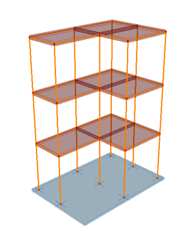
- have at least 4 floors (including the ground floor), fit within a 20cm by 30cmL-shape building area (see Figures 1 and 2) and be no more than 75 cm high.
- have a minimum floor area (above ground floor) of 700cm2.
 |
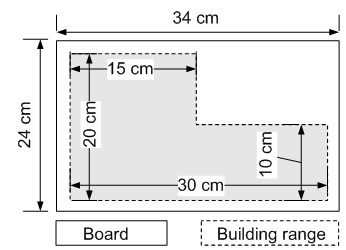 |
Figure 1 an example of a model |
Figure 2 Plan building range of your model |
On the day that you attend the PASHD (IDEERS) event, you will be given 6.5 hours (including a short break for lunch) to make your model.You will need to have planned your design and drawn up sketches before then to make sure that you have all of that time for constructing your model.You will be given the materials in advance of the 6.5-hour model building time.However, you may not start cutting or shaping the material or assembling the model, otherwise you will get punished.
For the event, all models will be tested on a shaking-table with different sized earthquakes.The first earthquake will be very small. Then the size of the earthquakes will be increased gradually, up to the maximal level of 800 gal (1 gal = 1cm/s2 of acceleration).
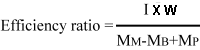
For every model, a note will be made of the number of blocks it is carrying, its mass and the size of the earthquake that caused it to fail (see FAILURE CRITERIA). These values will be used to calculate its efficiency ratio. The mass of a complete base board will be deducted from the total mass of your model.The efficiency ratio of each model will be calculated by dividing the size of the largest earthquake it survived by the mass of the structure above the base board and multiplying by the number of weights fixed on the floors of the structure (see Equation 1). The three models with the highest efficiency ratio will win 1st, 2nd and 3rd prizes for being the most-efficient models.
 ……………………………………………….. (Equation 1)
where,
I: Maximum intensity the model system survives
W: Weights fixed on the floors.
- For blocks on 2nd and 3rd floor, each block counts 1 weight. For blocks on 4th floor or higher, each block counts 1.5 weights (1st floor is the ground floor).
- To encourage the creativities on design, IDEERS 2007 accepts isolation designs for high-school and undergraduate teams. An isolation design allows sliding of steel blocks during earthquakes. The supplement rules apply if an isolation design is employed.
MM: Total mass of the model system (excluding steel blocks)
MB: Mass of the base board
MP: Weight penalty
For example, the total mass of the team ACE’s model system (excluding steel blocks, MM) is weighted 1200g while their mass of the base board (MB) is weighted 170g. Besides, they were judged to add 200g as weight penalty (MP). Meanwhile, the team ACE put 3, 4, and 5 weight blocks (W) on the 2nd, 3rd, and 4th floor seperately while they survived the 400 gal (I) shaking test. However, this model was collapsed during the following 500 gal shaking test.Therefore, the efficiency ratio of team ACE’s model will be as following:

If you want help on how to design your models, and you if can read English, you may like to find out about designing earthquake resistant buildings on the IDEERS reference site at www.ideers.bris.ac.uk.Look under the section on “Resistant Buildings.”
YOUR TEAM
For the PASHD challenge, you can work in a team with a maximum of 4 students and 1 advisor (of the same school), however, only students can hand-work on the making of the model.You will be competing against many other teams.Plan in advance what each member will be doing to make efficient use of the time you have for constructing your model.
Supplemental rules for isolations:
A. Isolation of steel blocks.
(1) Steel blocks are divided into ‘dead load’ and ‘live load.’
a. Dead load (DL) is to simulate the self-weight of the structure, therefore, DL must be fixed on the floor. There must be at least two steel blocks on each floor and twelve steel blocks in total for DL.
b. Live load (LL) is to simulate the weight of what the structure carries, therefore, LL can be isolated from the floor.
c. Total weight of dead load and live load must be less than or equal to 24 steel blocks.
(2) There are different failure criteria for DL and LL.
a. If DL moves due to failure of its fixing components, the relative displacement of DL must be less than 1cm, or it will be considered as failure. However, the relative displacement of DL is allowed to cross the edge of the structure as long as the displacement is less than 1 cm.
b. The relative displacement of LL must be less than 2 cm, or it will be considered as failure. Plus, the relative displacement of LL is NOT allowed to cross the edge of the structure in any circumstance.
c. Due to the difficulty of accurate measurement during the shaking, the relative displacement is visually estimated by referees.
B. Isolation of floor(s): Isolation of floor(s) differs from the isolation of steel blocks. Isolation of floor(s) isolates all structure parts and steel blocks above the isolation. Isolation of steel blocks isolates only steel blocks, their fixings, and accessory components.
(1) Only horizontal displacements are allowed for isolation of floor(s). If structural rocking occurs due to isolation, then it is considered as failure.
Note: Teams employing either isolation of steel blocks or floor(s) need to inform the referee. If the referee thinks steel blocks may fly out of the structure during earthquakes and may cause damage of other models, then the teams need to strengthen their mass fixings according to referee’s guidance.